Welcome to Our Global Management Blog
A Traditional Brazilian Lunch ~ Connor Wieland
Blog One
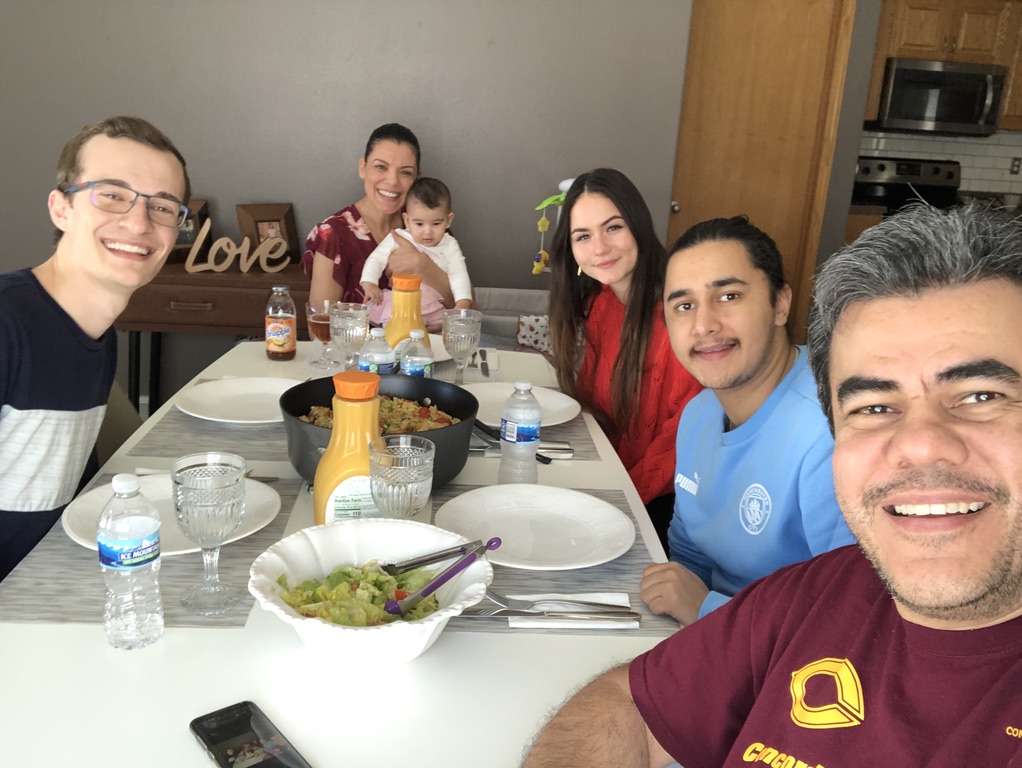
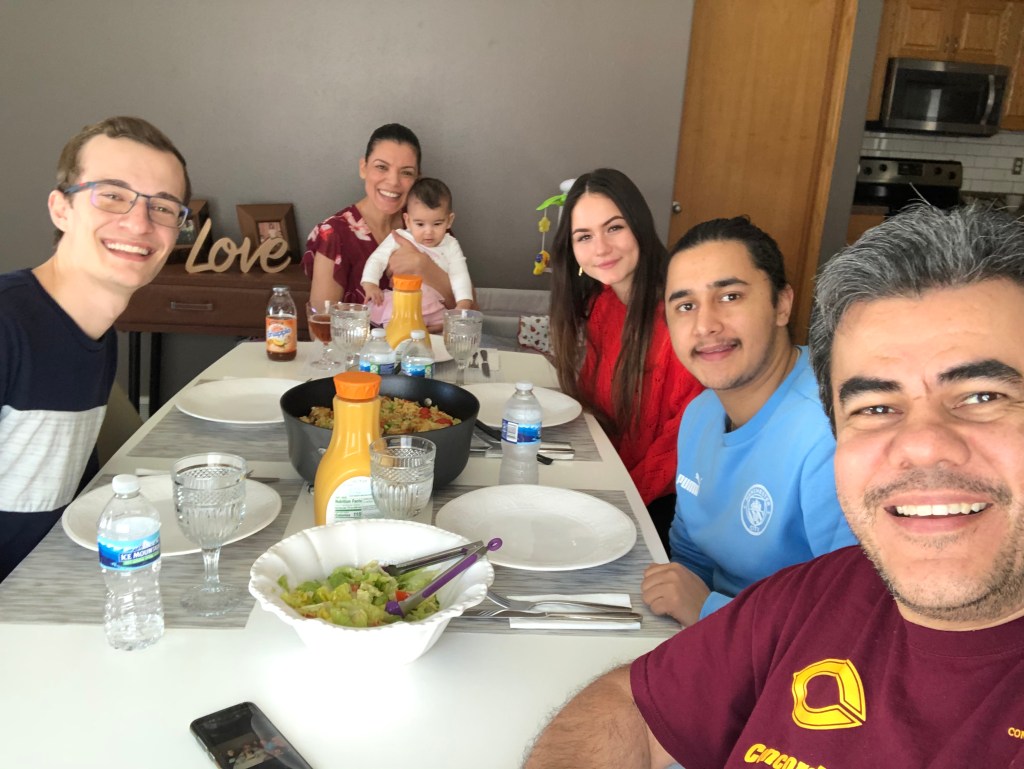
On Saturday, February 22nd, Julia, Shusham, and I were all welcomed with open arms into Dr. Scarpin’s home where we had a traditional Brazilian lunch with his wife Marcia and daughter Gabi. We participated in conversation about Brazil as a whole and made comparisons with different cultures while enjoying a delicious meal.
My entire life I have been surrounded by people who are very similar to me. A vast majority of the meals I have shared with others have either been very American or traditional German meals because of my family background. Being present for a traditional Brazilian lunch is not something I would have experienced if it were not for the goal of this assignment. Brazilian culture, from my understanding and experience, is revolved around tight knit communities and diverse populations. The country is full of vibrant communities, such as Sāo Paulo and Rio de Janeiro, that are full of different people. Portuguese, Italians, Germans, and Japanese all are different groups that are represented in Brazil, which was quite shocking to me. Sure, here in the United States we have a handful of cultures represented in our population but living in North Dakota and Minnesota my entire life has sheltered me from different cultures also represented here, whereas in Brazil they are a large part of the communities. From a food standpoint, Brazilian people eat mostly fresh foods. They have a wide variety of different fruits and vegetables not very common to people who live in the United States. Dr. Scarpin and Marcia both pointed out the struggle of finding foods here in the United States and how plentiful fresh foods were in Brazil. The entire culture was very different to me but I thoroughly enjoyed having the opportunity to learn more about it.
Immediately when we walked into the house we were greeted with big smiles and delicious smells. Going into this lunch, I had never had a face-to-face conversation with either Dr. Scarpin or Marcia, but they were so welcoming and kind from the start. I instantly started to feel excited about being there and having the opportunity to have an experience like that and began thanking them for hosting us. When I am in a situation where I feel very welcomed, I want to make sure they know how much I appreciate what they are doing. The first half of our time was spent sitting and having conversation with them and their baby Gabi about Brazil in general. We heard a lot of historical information about the country as well as what it is like to live in the different sub areas of Brazil. We looked at a map, watched some videos, and ultimately got to hear a unique personal perspective about Brazil from them.
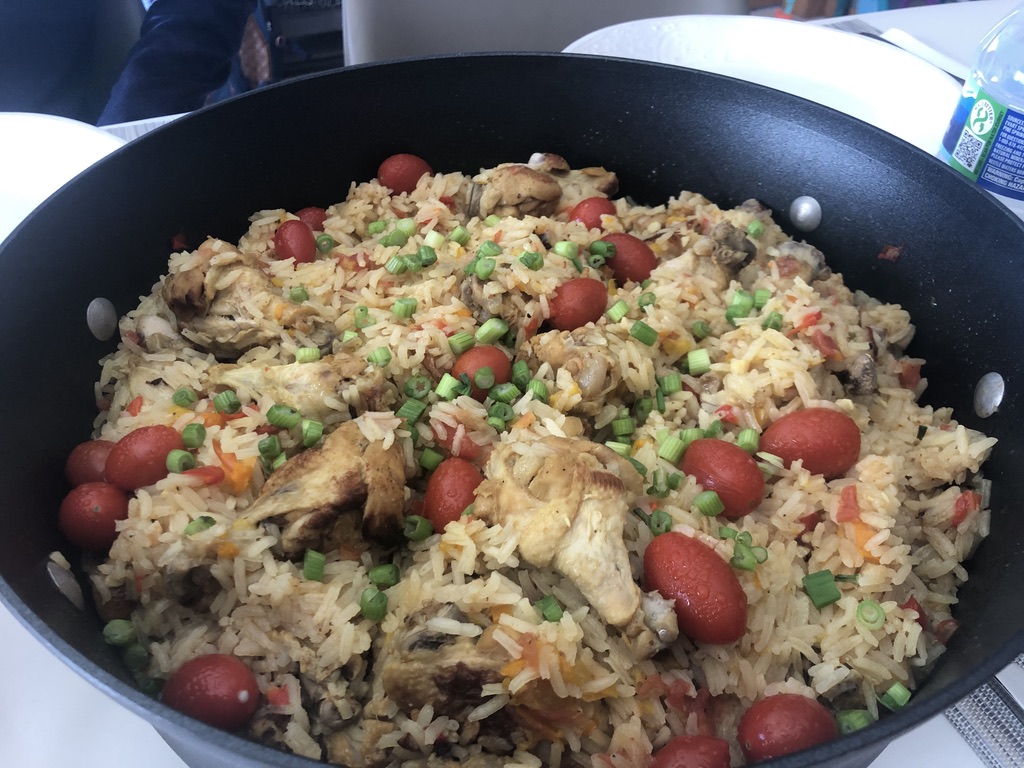

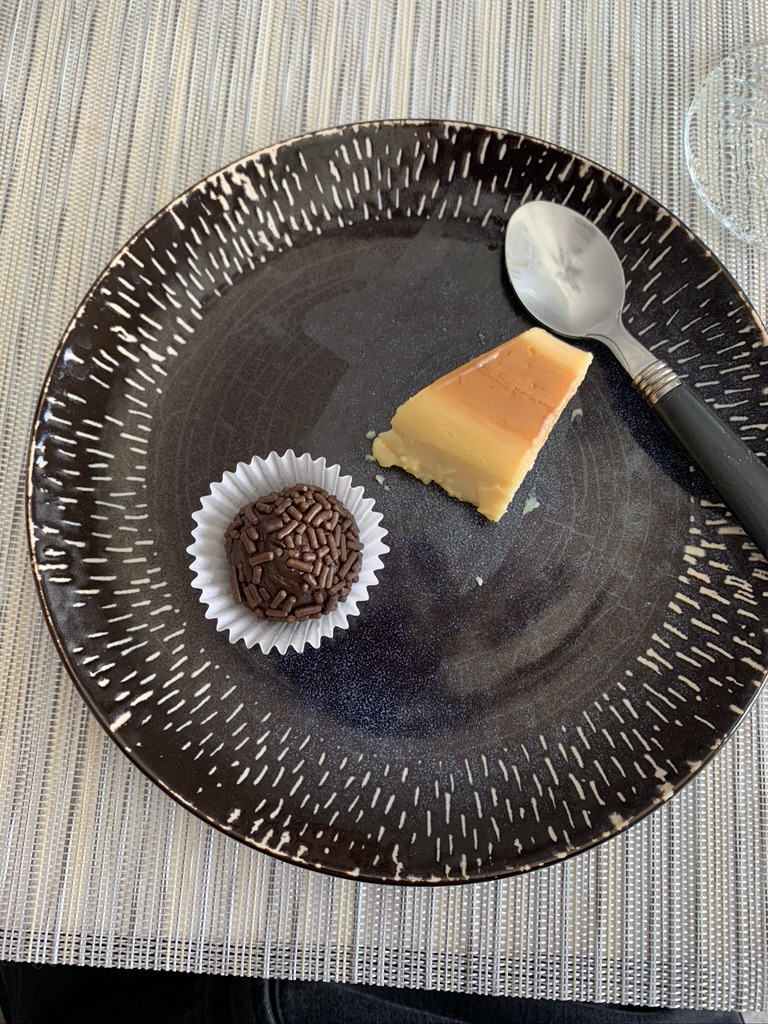
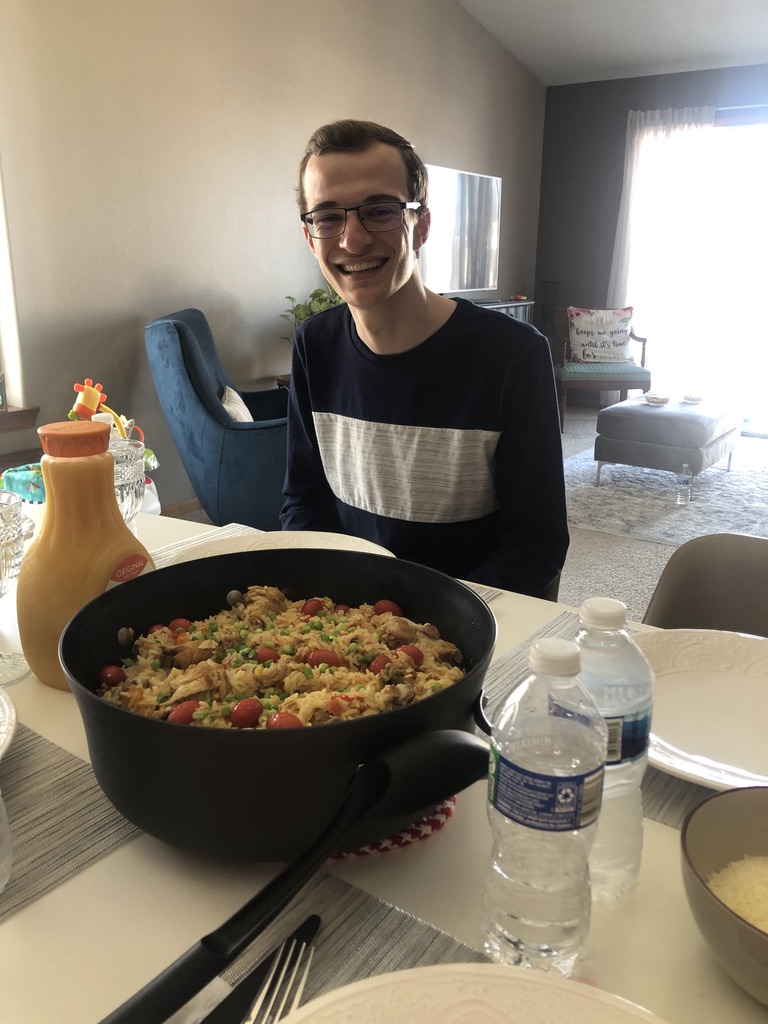
The second half of our time was spent having lunch. We were surrounded by delicious food. They had prepared a salad and a dish for us called galinhada, which means “a lot of chicken,” that was absolutely delicious. It was a pot full of rice, vegetables, and chicken cooked to perfection. While eating, we engaged in conversation about the different food traditions in Brazil as well as in Slovakia and Nepal, Julia and Shusham’s home countries. Following the main course, they brought out desserts: a sweetened condensed milk pudding and brigadeiro, a delicious chocolate treat. Being I have a sweet tooth; these desserts were to die for. I could not help but constantly think how gracious it was of them to have us and serve us all of this food. One of the aspects of culture I was successful with was making eye contact in conversation. I noticed that both Dr. Scarpin and Marcia made eye contact while engaging in conversation, so I tried with intent to make more eye contact than I normally would. I think this also translates to the business world. Knowing how people of different cultures make connections is important. One of the aspects of culture I was less successful with was how much food I should take. There were moments where I would watch others at the table to base my decision off of just because I was not sure how much was too much. When it came time for the three of us to leave, Marcia insisted that we take the leftovers with us. She packed each of us some of the main course and desserts to enjoy at home. I am always weary of taking someone else’s food from them, but she told us it was what people do where they are from, so I gratefully accepted it.
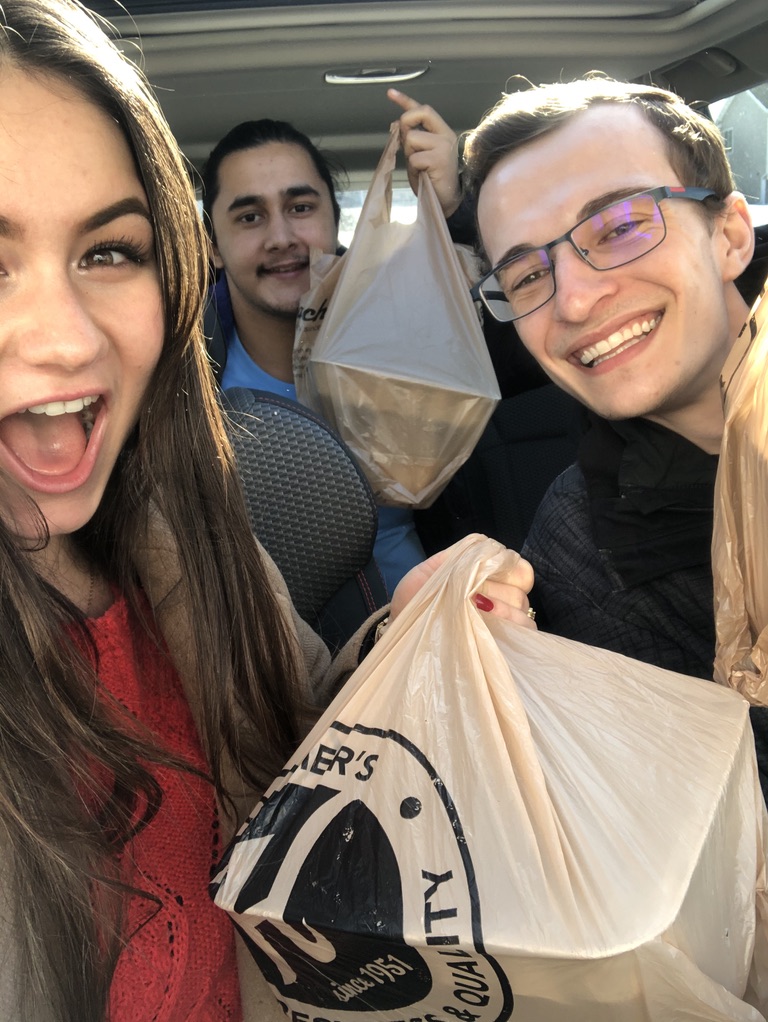
After leaving the Scarpin household, the three of us could not stop smiling. We enjoyed every minute of the lunch and were happy we decided to have this experience. In reflecting, there are a couple of things I would do differently to improve the interaction if I repeated this experience despite it being wonderful already. First, I would come to the lunch with more questions to ask. Dr. Scarpin and Marcia were excited to talk all about their culture but sometimes I ran out of things to ask, so coming with a more curious mindset and questions could enhance our conversations further. Showing curiosity in the business world is another thing I think is important when dealing with people of different cultures. If you make assumptions about someone else’s culture, that can backfire very quickly. Another thing I would do differently is ask them more about how they got to where they are now. Sometimes I felt like our conversation just revolved around Brazil and not around the people who were hosting us. In doing this, I believe my interest in them would show more and our interaction would be enhanced. At the end of the day, I could not be more grateful for the stellar experience that I had at the Scarpin’s home.
Traditional Brazilian Lunch ~ Júlia Ozaniaková
Blog Two
What a bummer I have not had a chance to take a class with Dr. Scarpin throughout my time at Concordia. Seriously. Dr. Scarpin, his wife Marcia and their cutest baby girl Gabi are some of the nicest people I have ever met in my life. Not only have Connor, Shusham, and I enjoyed the best (and my first) Brazilian lunch in Scarpin’s lovely home, but we were given the opportunity to learn more about the geography, history, landscape, and culture of Brazil from the first-hand source!
At first, Connor, Susham, and I struggled a bit when trying to find the perfect diverse experience for this project. Because Susham and I are international students, we wanted to choose an experience that would expose us to a culture we were not familiar with at all. When we asked some of our friends and classmates for recommendations for this project, numerous people recommended us Dr. Scarpin. The only concern we had was the fact that none of us have taken a class or worked on any other project with Dr. Scarpin before. One day, Connor ended up reaching out to Dr. Scarpin and we were truly surprised by his quick and very positive response. We decided to have our event on Saturday, February 22 as that was the best time that worked for everybody.
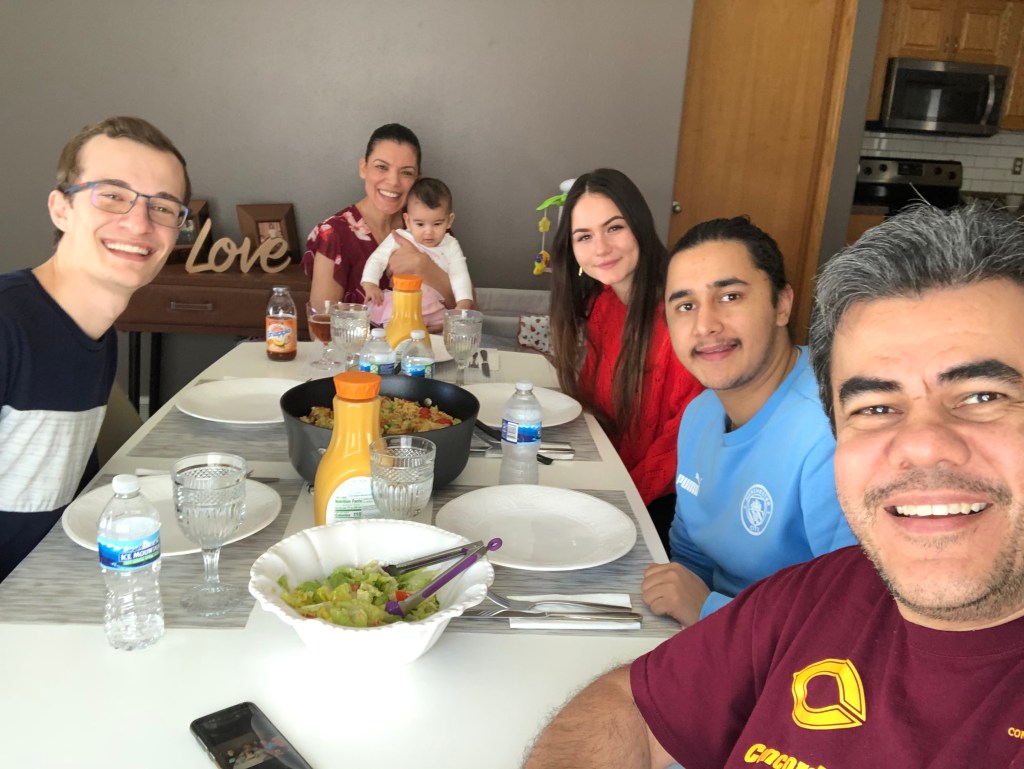
I remember that the car ride to the Scarpin family’s house was little stressful and full of anxiety. None of us were sure about how this lunch would proceed, what we would talk about, and how awkward will it be. However, from the very first moment when we entered Scarpin family’s house, I felt confident that the time spent with the Scarpins will be special and something truly amazing.
Dr. Scarpin broke the awkward silence after our little introductions with a prepared presentation about Brazil. We learned a lot about the Brazilian culture, its landscape as well as about its economy. I could tell both Dr. Scarpin and his wife Marcia are proud of their country and culture and truly miss it. However, it was nice to see how they brought little bit of Brazil into their American home. I think both Susham and I could relate to some of the struggles of living in a different country and missing some aspects of the culture we grew up in.
Although I do know some people that are from Brazil, I have never eaten any Brazilian food prior to this lunch with Dr. Scarpin. I was pleasantly surprised when I saw that the lunch we had had rice and lot of vegetables as well as side salad as I truly enjoyed homemade meals with fresh ingredients. Galinhada, the Brazilian traditional meal that literally means “lot of chicken,” was delicious and all of us ended up getting seconds. While we were eating, we had multiple conversations about the cultures we grew up in and I was pleasantly surprised to find out that Brazilian and Slovak cultures are quite similar in their cooking and eating habits. Both Brazilians and Slovaks do not use many spices (this is one of the reasons why even cinnamon or ginger are too spicy for us), but we do like to spend at least an hour to eat our lunch and talk with other people. This is something that I believe translates into the business world. When interacting with people from different cultures, one has to understand the importance of taking time to get to know others and take a longer period of time for eating that one might be used to. Networking and doing business abroad or with people from other cultures might have different aspects and one has to be prepared for that. I am a firm believer of always asking other people about their traditions and be genuinely interested in their cultures and countries.


After we were done eating Galinhada and the salad, Marcia surprised us with two desserts. One of the desserts was caramel pudding made out of condensed milk and the second one was Brigadeiro, traditional Brazilian dessert made out of condensed milk, dark chocolate, and butter. (I know this because the Brigadeiro was so good I had to ask for a recipe). I think Connor and I were enjoying the dessert way too much and we ate multiple pieces of both the pudding and Brigadeiro. Dr. Scarpin mentioned that he and Marcia host regular international dinners where they invite international students and eat food and have fun. He mentioned to reach out to them whenever I feel homesick or lonely as they both understand the struggles of living so far away from home. This made me feel truly welcomed and gave me the feeling of wanting to visit them again.

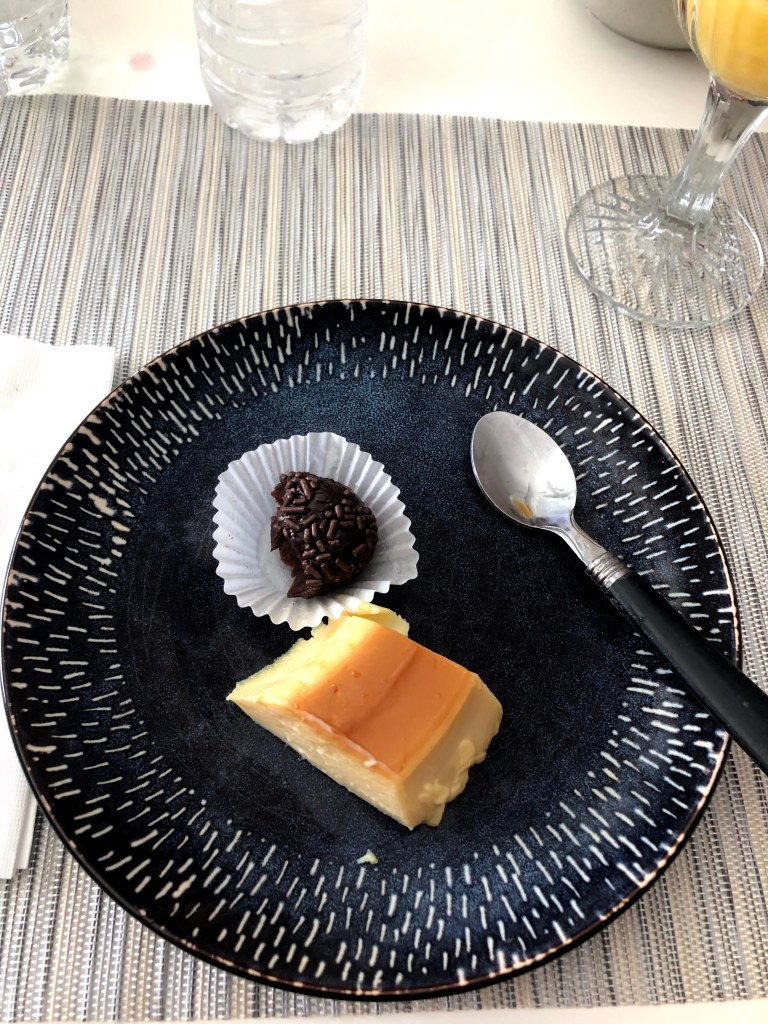
Once we were done eating (way too many) of the delicious desserts, Marcia offered us coffee. However, because at this time we were at their house for over 3.5 hours and had other commitments that day, we had to decline this opportunity. This is something I regret and I wish we had more time to spend with Dr. Scarpin, Marcia, and Gabi. Additionally, I wish I brought something from Slovakia for the Scarpin’s family or made something on my own as well. The Scarpin family has prepared so much for us and I felt bad about only coming in with a Thank You card. Marcia insisted that we take some of the leftovers from the lunch home with us. Again, this is something that is part of numerous cultures and it may come off impolite to decline such offer. I decided to share my leftovers with some of my other friends who enjoyed it as well.
Overall, I believe that it is very important to be aware of the traditions and customs of other countries when interacting with diverse groups of people. This is very important in the business world as not being familiar with differences can create awkward or uncomfortable situations. It is also very important to stay curious and be open and appreciative of new experiences as well as cuisines. Having a traditional Brazilian lunch in the beautiful home of Dr. Scarpin and Marcia’s has been one of the highlights of my time at Concordia and I am very grateful for that. I am excited about the fact the Scarpin family hosts dinners for international students and thanks to this opportunity, Dr. Scarpin added me to the list of the students they regularly invite to their home.
An Unforgettable Sushi Dinner ~ David Dai
Blog Three
At the first time, I can’t make to the event with my group. A few days ago, I was invited to his home for dinner by my Japanese classmate Ashka. He asked me if I wanted to learn to make sushi with him, and I was excited. Because I’ve always been interested in Japanese food, especially sushi. This time I had a chance to learn how to make sushi, so I immediately promised to visit his house.
While making sushi, my classmate explained the culture of sushi to me. He said that the thickness of sashimi, the temperature of rice and even the strength of kneading rice balls can affect the taste and taste of sushi. I quite agreed with him and admitted such a fine operation is beyond the reach of Chinese cuisine. Extremely meticulous attitude helps to achieve great cause, which is probably why Japanese cuisine can conquer the world and Japanese cuisine culture can spread all over the world.
After he made a plate of sushi, he began to teach me hand in hand. He explained to me the simplest way. First, lay the rice flat on the porphyra as quickly as possible, or the porphyra will absorb water and become soft. Second, add roasted porphyra or egg slices and pickles while serving rice. Then wrap the porphyra and rice tightly with a bamboo curtain. This is one of the easiest way.
When he cut the sushi and put it in front of me, I was so glad that I couldn’t help but pick up one with my hand. He stopped me hurriedly, and said “why not try the vinegar? The sushi must not be without vinegar. Do not underestimate the effect of vinegar. It can make rice taste more delicious and keep sushi fresh.”
We continued to chat while tasting our home-made sushi. When we talked about Japanese food culture, I stated, Japanese cuisine is becoming more and more common in Chinese recipes, and many Chinese like sushi very much. But when it comes to making sushi by hand, I’m afraid many people have to shake their heads.
In addition, we discussed the nutritional value of sushi. It contains low heat and carries low fat. At the same time, it is very delicious because of the freshest fish raw. With ultra-low calories, fire-free raw food, organic ingredients, fresh taste, beautiful shape, sushi is simply enough to satisfy all people’s imagination of food. This is the reason why Japanese cuisine has gradually become popular around the world. Among them, sushi is especially the ultimate expression of this simple food culture.
On my way home alone, I couldn’t help thinking, the Japanese cuisine culture insists on digging up the taste of food among the limited ingredients and doing its best to study the purest taste of food. That’s why sushi sashimi originated in China, but it can spread around the world with the efforts of Japanese. It has to be said that there are many virtues in Japanese culture.
History, Geography and Way of Life in Brazil along with the Traditional Brazilian Cuisine ~Shusham Bir Bhujel
Blog Four
History, Geography and Way of Life in Brazil along with the Traditional Brazilian Cuisine. -Susham Bir Bhujel
The very reason why I came to the United States is to learn about new culture, tradition, beliefs and way of life. Being an international student I see myself thriving for opportunities where I can share and learn about new cultures. Similar opportunity came in my life when we were tasked to do a project where we were supposed to engage ourselves in an event that will help us learn about a new culture and tradition. Being in a diverse project team with me coming from Nepal, Julia coming from Slovakia and Connor who is from America finding an event that will be new for everyone seemed hard at the beginning. As we sorted out our options a meal at Dr.Scarpins place would be the best fit for all of us. Dr. Scapin did not take any time responding and accepted to host us for lunch on February 22nd, Saturday. It wasn’t just an ordinary lunch but was also an opportunity to learn about the history, geography, culture and tradition of a country I have always dreamed of traveling to Brazil. As we sat in the car all three of us were anxious about how this lunch is going to be. The warm welcome that we received from Dr. Scarpin, his wife Macia and their cute daughter Gabi cheered us up and made us feel like home.
Dr.Scarpin pulled out a world map on his TV screen as we sat down in his living room. He started us up with the geography and landscape of Brazil. We learned about Amazon Rainforest covering 60% of the total land and Brazil being the number one country with most renewable freshwater resources. Moving on to history we learned about why and how the Brazilian capital changed Rio to Brasilia, how Brazil allowed people from Germany and Portugal to come to Brazil and be their citizens and the relationship that Brazil has with its neighbor nations. I wasn’t expecting this to happen. I am grateful that Dr. Scarpin and his wife sat us down and acknowledged us about Brazil. What really stood out to me was the fact that how proud both Dr.Scarpin and his wife Marcia were to be from Brazil. He really motivated me in how someone can love their country even though they work offshore. As he talked about Brazil he continuously asked me and Julia about the geography, history and way of life in our country. So not only did we learn about Brazil but also we learned a lot about Slovakia.
It was then time for lunch. As we started eating Galinhada(traditional brazilian lunch) it reminded me of home. The spices and the meal was very similar to a meal called Biryani in Nepal. In terms of food Nepal and Brazil looked very similar as both countries eat rice as their staple food. After the delicious lunch and wonderful conversations the Scarpin family didn’t allow us to go back with empty hands. Marcia packed us the leftovers and told us that it is a tradition in Brazil that you don’t let guests leave the house empty handed.


How Brazilian Businesses Are Dealing With the Coronavirus Pandemic ~ Ana Claire Rue
Blog Five
As people today have started calling earth a global village it is really important to be aware about different cultures, traditions and way of life. Business firms give great importance to the employee diversity and having knowledge about different cultures helps support diversity. Overall I am really thankful that we were tasked to do a project like this. Studying in a college where a lot of students have never engaged in a culture, tradition different then their own this project is a great experience and a way to produce students that are capable of being responsibly engaged in the world.
In these challenging and uncertain times, people around the globe have had to make major adjustments to their daily lives. Social distancing has become the new “normal,” and as a result schools have shifted to online learning and many businesses have closed or drastically altered the way in which they carry out their operations. Some organizations were well-equipped for this change, which made the transition to remote work go relatively smoothly. However, some companies have resisted the possibility of remote work in the past, and managers are left scrambling for contingency plans in order to keep up their productivity while following the new mandates. The article, When It’s Impossible to Work Remotely: How Brazilian Businesses are Dealing With the Coronavirus Pandemic, highlights some of the challenges Brazilian businesses have faced in these unprecedented times.
When the article was written, Brazil had only 612 confirmed cases and 7 deaths, but officials knew the number of cases would be increasing exponentially before the outbreak eventually peaks. The government is exercising a high degree of caution, which has left the country with extremely high unemployment levels. According to the Brazilian Institute of Geography and Statistics, over 11.9 millions Brazilians are currently out of work. This mass unemployment is causing panic about income as well as health amidst this global crisis. Many companies have never adopted flexible mindsets about remote work, and they are finding themselves unprepared as the crisis becomes more urgent.
For some companies, working at home is impossible, which is causing a lot of anxiety among its employees. The resistance stems from a lack of trust between managers and employees. An anonymous senior staff member at a traditional Brazilian publishing house told ZDNet, “Our management has always resisted against allowing us to work remotely – there seems to be a need to be looking over our shoulders and micromanage employees. They won’t listen to our suggestions to implement even free collaborative systems.” The structure of many of these offices has been based upon the amount of hours spent in the office as opposed to actual results delivered.
Another setback in the transition to remote operations has been the lack of the legal framework regarding this situation. Dirceu Santa Rosa, a partner at Brazilian Law Firm Montaury Pimenta, Machado and Vieira de Mello and specialist in digital law, recently noted, “We are seeing masses of people who were mainly working under desk-based, traditional arrangements now having to work from home, which was until recently associated mainly with freelance activities. The Brazilian legislation is not prepared to account for situations like that.”
Companies that are experienced in virtualizing their operations know how to drive employee morale and manage productivity remotely. The companies who had previously resisted remote work are facing a steep learning curve on these processes but are staying optimistic in the face of uncertainty. They are striving to quickly develop a solid virtual foundation that is best for management and employees. They are working diligently to find a balance between safety, productivity and physical and mental health. There is hope that the changes introduced during the crisis will positively impact their workplaces in the future, bringing increased productivity and morale. Until the restrictions are lifted, they will continue to follow the learning curve and try to improve their operations remotely.
Pulling Everything Together: Culture & Business
Final Blog
We have learned a lot through our individual and unique cultural experiences not only about different cultures, but how we can become better future leaders in business. Here we will highlight a handful of key takeaways we all took from our experiences.
Be Curious and Intentional
One of the lessons we pulled away from our cultural experiences was the importance of being curious and intentional in the business world. Showing curiosity when meeting and managing people of different cultures shows you want to get to know and build a positive relationship with them. In the case with Dr. Scarpin, the three of us being curious about the Brazilian culture opened up healthy and interesting conversation and gave them the opportunity to educate us on something near and dear to them. Forming healthy relationships with people you work with is super important in the business world and being curious is just one thing we found to help with relationship building.
On the other hand, being more intentional was something we found we could improve upon when dealing with people of different cultures. When navigating the diverse workforce, being intentional about asking people about their needs, work-styles, and viewpoints will only help bring diversity of thought into the equation. In the business world, being intentional about goal setting, asking questions, and maintaining relationships are all things that can help businesspeople thrive. We believe that if we would have been more intentional about bringing questions and thoughts to our Brazilian lunch that we would have learned even more than what was prepared by the Scarpin family.
Generosity and Preparedness
Another lesson we took away from this experience is the importance of generosity and preparedness in the professional world. Being prepared and knowing the background of someone’s work or culture is essential when networking, socializing on both personal and professional level, working and striving for excellence in a business setting and more. Generosity is a crucial part of numerous cultures and being aware of that is significant.
During our lunch experience with Dr. Scarpin and his family, we realized how extremely generous they were to us the whole time. Although we prepared for the time spent with them by researching and learning about the Brazilian culture and food prior to coming to visit them, we felt like we could have done a better job in being better prepared and more knowledgeable when discussing our thoughts after the experience. We wish we prepared a meal on our own or brought a meaningful gift that we could have given to the Scarpin family after everything they prepared for us. Being prepared and knowing things about one’s culture or background serves well when building new relationships. Accepting and providing generosity is a valuable asset in relationship building as well. I cannot stress enough how important it is to be prepared and being adaptable when dealing with a diverse workforce. Preparedness and generosity are crucial parts of understanding one’s culture while staying respectful and showing appreciation in relationships.
Workplace Diversity & Knowledge
As companies are tilted more and more towards corporate social responsibility, diversity in the workplace has been something companies have started giving importance to. Being someone who is looking to forge a career in business I strongly value learning about new culture, tradition and way of life. Not just for me but for all of the team members learning about new culture is something that they value. Knowing one’s culture, tradition and way of life makes it easier for us to connect to them. With businesses giving importance to diversity, every new culture we learn is certainly valuable.
Dr. Scarpin was talking about how he is among few other Concordia staff who are international and how he had adjusted to an environment so new and different than the one he grew up in. Being an international student it just motivated me to be confident and clear about my culture and background to others. People have different backgrounds and have their own ways of doing things so just being mindful of the environment around you is another hot take for me from my lunch at Dr. Scarpin’s place. For me this project helped to realize that Awareness, Open Mind, Acceptance and Respecting for one’s diversity is really important in achieving success as a business personnel in the future.
Patience in the Workplace
A lesson I learned from the sushi experience is that everything starts small and you need to be patient about small things, not ignore them. The Japanese focus on the small things in their cuisine helps make a large impact in the quality of the food. They always spend days on choosing raw material and fish, they are seeking perfection for food. In my point of view, this also reflects what we need to do in the workplace.
To be a good leader, especially these days, patience is really important. Every leader feels all kinds of pressure, for example building a team and getting good outcomes. At the same time, employees still have a lot of work to do and use the extra hours. Under this time, we’re all human, the emotion brought to us in this situation will lead to impatience in the work, this will cause us to be inefficient or give up on a challenging task. I once had a supervisor who lacked patience. He was an older man who never had enough time or didn’t want to hear about his employees’ concerns.
How to develop patience in the workplace? I will give the following points that a leader or employees can practice in daily life. First, everyone should listen and ask questions with a positive attitude. Second, use other people’s perspectives to think about a problem. Third, don’t run away from a problem, start solving even a tiny part. I hope this idea helps you at your workplace.
Building Trust
Another takeaway from this project is the importance of building trust between managers and employers. Especially during these challenging and uncertain times, building a solid foundation of trust is more important than ever. With the transition to remote work around the world, employees need to feel confident that their superiors are making the best decisions for the company as well as for the individual within the company. On the other hand, managers and employers need to be able to trust that their employees are keeping up their productivity from home. There is little to no supervision for employees working at home, but the company is counting on them to continue to do their best work. If a company has a good relationship with its employees, the employees will feel a greater sense of devotion to the company. This will motivate the employees to continue working to the best of their abilities. We can use this knowledge in our future careers as both employees and potentially managers. Trust can improve morale, turnover rates and employee loyalty and can also strengthen the company in difficult times.
 Management Blog